
Each year Cementir identify sustainability topics that are relevant to the Group and its stakeholders.
The definition of material topics
In 2024 the Group adopted the Corporate Sustainability Reporting Directive (CSRD), introducing the principle of Double Materiality Assessment (DMA), which considers two dimensions:
- Impact materiality: the impacts generated by the Group and its value chain on people and the environment;
- Financial materiality: the impacts of ESG issues on the Company’s economic and financial performance.
Our Double Materiality Assessment
In 2024, Cementir carried out an assessment process of Impacts, Risks, and Opportunities (IRO), which led to the definition of the Group’s material topics.
In 2025, the double materiality analysis was significantly strengthened through:
- increased granularity and more advanced methodologies, particularly in the environmental area and along the value chain;
- expansion of the social dimension , particularly on the value chain and health and safety,
- governance focused on financial, legal and reputational risks related to corporate conduct and violations (corruption, AML, market abuse, whistleblowing).
This evolution reflects the growing maturity of the Group’s due diligence processes.
The Company’ strategy is supported by the Enterprise Risk Management (ERM) system, which includes the analysis of climate-related risks, and is continuously updated based on risks monitoring and scenario analysis.
The Sustainability Statement is prepared in accordance with the European Sustainability Reporting Standards (ESRS) issued by the EFRAG and provides the information on the entire Group, covering the main value chain and the IROs identified across upstream, downstream, and own operations.
The list of material topics, defined by the Sustainability Department together with relevant functions, is classified into Environment, Social, and Governance. It reflects a comprehensive and structured framework fully consistent with the Group’s strategy and provides a complete sustainability disclosure.
Outcome of the Double Materiality Assessment
The outcome was performed in terms of ESRS topic and sub-topic; the sub-topic highlighted are the ones defined as material.
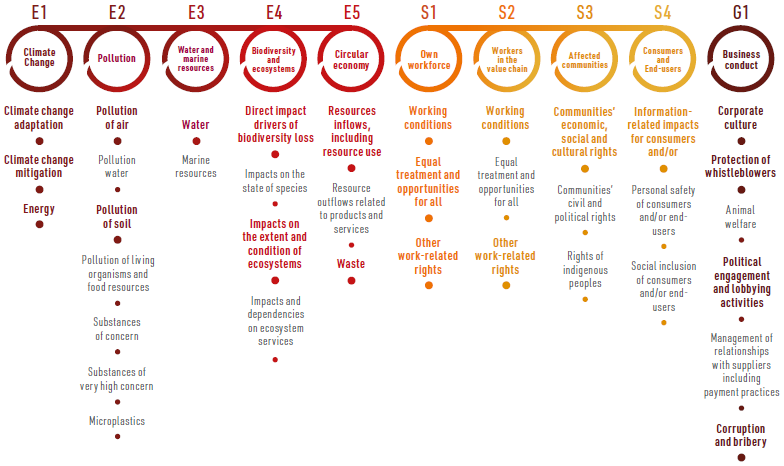
Outcome of the Double Materiality assessment
TRANSCRIPT - Outcome of the Double Materiality assessment
Environmental (E)
E1 - Climate Change: All material: Climate change adaptation, Climate change mitigation, Energy.
E2 - Pollution: Material are Pollution of air and Pollution of soil. Not material: Pollution of living organisms and food resources, Substances of concern, Substances of very high concern, Microplastics.
E3 - Water and marine resources: Material is Water. Not Material is Marine resources.
E4 - Biodiversity and ecosystems: Material are Direct impact drivers of biodiversity loss, Impacts on the extent and condition of ecosystems. Not materials are Impacts on the state of species, Impacts and dependencies on ecosystem services.
E5 - Circular economy: Material are Resources inflows, including resource use, Waste. Not material: Resource outflows related to products and services.
Social (S)
S1 - Own workforce: All materials: Working conditions, Equal treatment and opportunities for all, Other work-related rights.
S2 - Workers in the value chain: Material: Working conditions, Other work-related rights,. Not material: Equal treatment and opportunities for all.
S3 - Affected communities: Material: Communities' economic, social and cultural rights,. Not material: Communities' civil and political rights, Rights of indigenous peoples.
S4 - Consumers and End-users: Material: Information-related impacts for consumers and/or end-users. Not Material: Personal safety of consumers and/or end-users, Social inclusion of c
onsumers and/or end-users.
Governance (G)
G1 - Business conduct: Material: Corporate culture, Protection of whistleblowers, Political engagement and lobbying activities, Corruption and bribery. Not Material: Animal welfare, Management of relationships with suppliers including payment practices.
Who our Stakeholders are
We change methods and frequency of involvement of our stakeholders depending on the type of subject, topic of interest and local features. In consideration of the nature of “Holding” of the Parent Company, some of these stakeholders interface directly with the central structures, while others are strictly interested in local activities and the relationship with them is therefore delegated to local management. We work to build a strong and long-lasting relationship with all of them, as we are aware that cooperation is an important and powerful value that enables the Group to better achieve its results, long-term sustainability and improve its positive impact on people and society.
The main Group stakeholders and the corresponding topic of interest are listed below.
Stakeholders and topic of interest
-
Personnel
Cybersecurity and data protection
Diversity, Equity and Inclusion
Health and Safety
Human rights
Industrial relations
Innovation
People management and development
-
Institutions and Authorities (local and national)
Climate change and GHG emissions
Competitive behaviour and business ethics
Energy management
Health and Safety
Human rights
Industrial relations
Innovation
Other air emissions (different from GHG emissions)
Regulation
Waste and Hazardous Materials Management
-
Shareholders
Climate Change and GHG emissions
Business performance and consolidation
Competitive behaviour and business ethics
Regulation
Health and Safety
Human rights
-
Trade Unions
Human rights
Industrial relations
-
Local communities and local committees
Circular economy
Climate change and GHG emissions
Community engagement
Human rights
Other air emissions (different from GHG emissions)
Waste and Hazardous Materials Management
Water management
-
Customers
White cement (quality and application)
Customer management
Fair competition
Innovation
-
Suppliers and contractors
Circular economy
Health and safety
Reliable and Sustainable value chain
-
Environmentalist Associations
Biodiversity
Circular economy
Climate change and GHG emissions
Energy management
Innovation
Other air emissions (different from GHG emissions)
Waste and Hazardous Materials Management
Water management
-
Financiers
Business performance and consolidation
Competitive behaviour and business ethics
Regulation
Transparency and accountability